
This project started as a method to empirically determine the FoV (Field of View) of a selection of lenses.
The FoV of Rectilinear Lenses can be readily determined using trigonometry* or graphically, but this is not the case with Fisheye lenses where, if the focal length is short enough, the image can be a circle with a 180° FoV.
* FoV of a side = 2 x ( arctan ( ( Length of side / 2 ) / Focal Length )
There were two requirements to complete this; a protractor with a suitable radius and a method of rotting the camera around the principal ray (axis) of the lens so that the camera did not need realigning when switching between portrait and landscape orientation and being able to slide the camera towards or away from the centre of the protractor so that the NPP (No Parallax Point) of the lens as coincident with the centre of the protractor.
A board large enough for a protractor with a 500mm radius was available so a scale bar divided into 180 one degree segments was created in a CAD application as it needed to be 1507.8mm in length (each degree represented by 8.73mm). This was taped to the board in a semicircle with the 500mm radius.
 To enable the camera to be rotated about and slid along the lens axis a mount was designed in CAD and 3D printed as this was both the most accurate and easiest method of created this. Rails, which were mounted on a conventional tripod, were created using materials salvaged from previous projects. This assembly was set up so the lens axis was aligned with the 0° point on the protractor and each lens positioned so that the NPP coincided with the centre of the protractor and the scale bar photographed in both portrait and landscape orientation. The FoV was then determined by viewing the images. This was done for a selection of Fisheye lense and two Rectilinear lenses were included as reference (i.e. to see that the result was the same as calculating the FoV for the Rectilinear lenses.
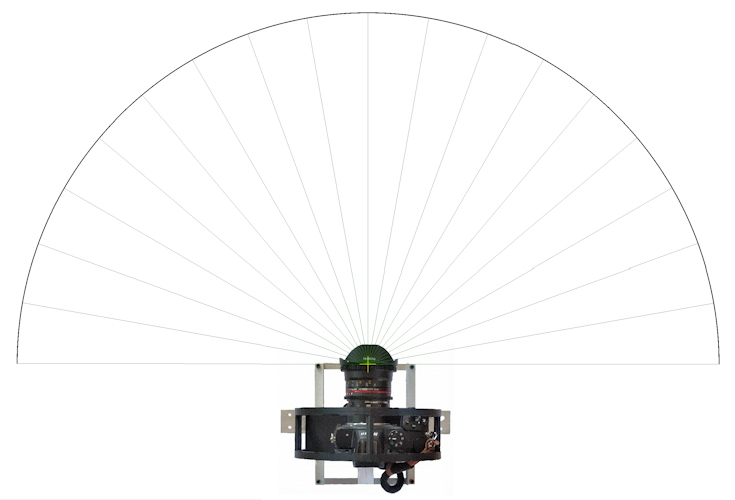
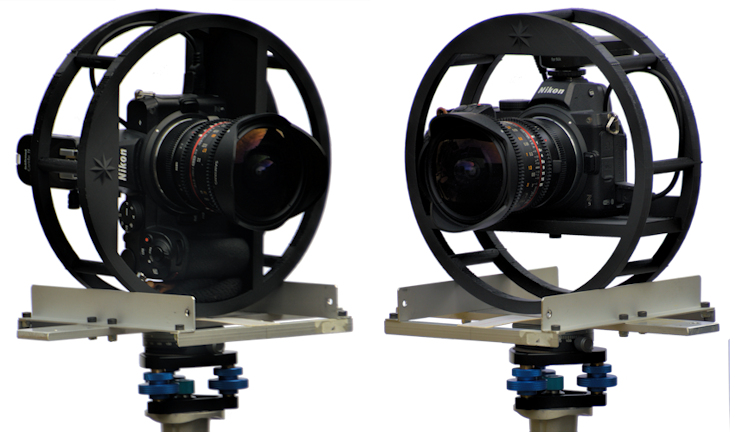
While viewing the images it was apparent that the characteristics of the lense was evident from the variations of the one degree segments on the scale bar.


Result from the empirically determined FoV:
| Lens | Full Frame (FX) Sensor | ||
| Nikon 10.5mm | Fisheye | 187° | 144° |
| Pergear 7.5mm | Fisheye | 183° | 152° |
| Samyang 12mm | Fisheye | 149° | 106° |
| Samyang 14mm | Fisheye | 108° | 84° |
| Sigma 10-20mm @ 10mm | Rectilinear | 121° | 106° |
| Sigma 10-20mm @ 20mm | Rectilinear | 79° | 64° |
| Tokina 10-17mm @ 10mm | Fisheye | 182° | 141° |
| Tokina 10-17mm @ 12mm | Fisheye | 182° | 118° |
| Tokina 10-17mm @ 14mm | Fisheye | 152° | 98° |
| Tokina 10-17mm @ 17mm | Fisheye | 129° | 85° |
| Vitrox 14mm | Rectilinear | 103° | 78° |